I am an evolving artist living in Petaluma, CA. My work can be seen at the Riverfront Art Gallery in Downtown Petaluma, and over the donor board at Petaluma Valley Hospital. I have been painting seriously with watercolors since 2001 and have currently added paintings using oils, acrylics and encaustic (wax) to my portfolio. The blog will be my attempt to share my new paintings with the wider world. Please do not hesitate to contact me if you are interested in learning more. All images are copyrighted and may not be used without my permission.
One of the earliest of our family groups to have landed in North America is the Gillette brothers. Jonathan and Nathan reportedly arrived in Massachusetts in 1633. The book New England, The Great Migration and the Great Migration Begins 1620-1635 compiled by the New England Historic Genealogical Society documents their arrival from Chaffcombe, Somersetshire.
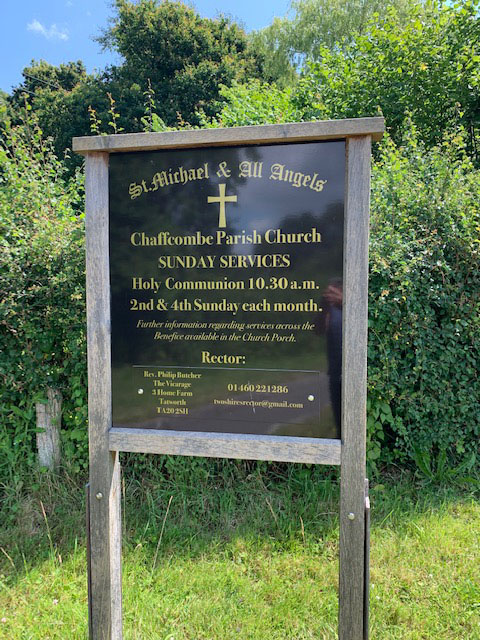
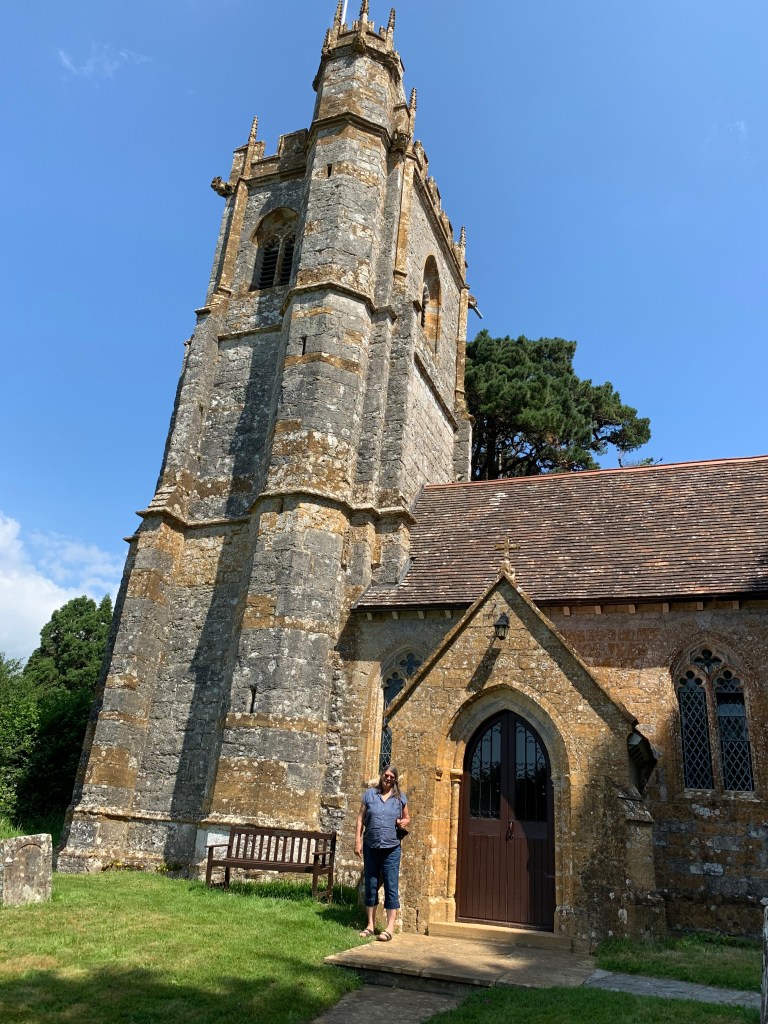
Sons of a pastor William Gillett who resided at the church in Chaffcombe, Devon, England (As shown below. We visited a few years ago and took these pictures then.), Jonathan and Nathan presumably left to come to the New World seeking religious freedom, but we really don’t know for sure. Nathan left behind property which he deeded to his father, so one can imagine that land ownership was probably not the motivation.
The current Chaffcombe Parish Church
Marilee in front of the Chaffcombe Church
According to the entries in the Bear Bible (Breeches bible…see an earlier blog), Jonathan’s son Benjamin writes that “My father Gillett came into the new-inglan the second time in June in the year 1634…” Our family traces their line back to John (1644-1682), a brother to Benjamin.
The family emigrated with a group of families that came from the West shore of England on the ship the William and Mary. Although they are found on some passenger lists for this ship, the NEHGS cannot confirm they were indeed on it. Both brothers are definitely here in 1634, but did they come on the William and Mary?
The William and Mary group initially settled on the Eastern Seaboard of Massachusetts, but found the Puritan rules to be too restrictive. They moved further west to Dorcester, but even the rules there were too onerous for their taste. The group then moved even further into the wilderness, finally settling in Windsor, Connecticut, just north of Hartford.
In 1634, Jonathan almost immediately returned to Chaffcombe to marry Mary Dolbere and to bring her back to Dorcester. We know for sure that their names were found on the manifest of the ship Recovery, which brought them back to the New World. (TAG 15:210; NGSQ 71:171, 77:250) According to the NEHGS research, Jonathan and Mary left Dorcester sometime before 20 Jun 1638, shortly after their first child Mary was born. All of their other children were born in Windsor, CN.
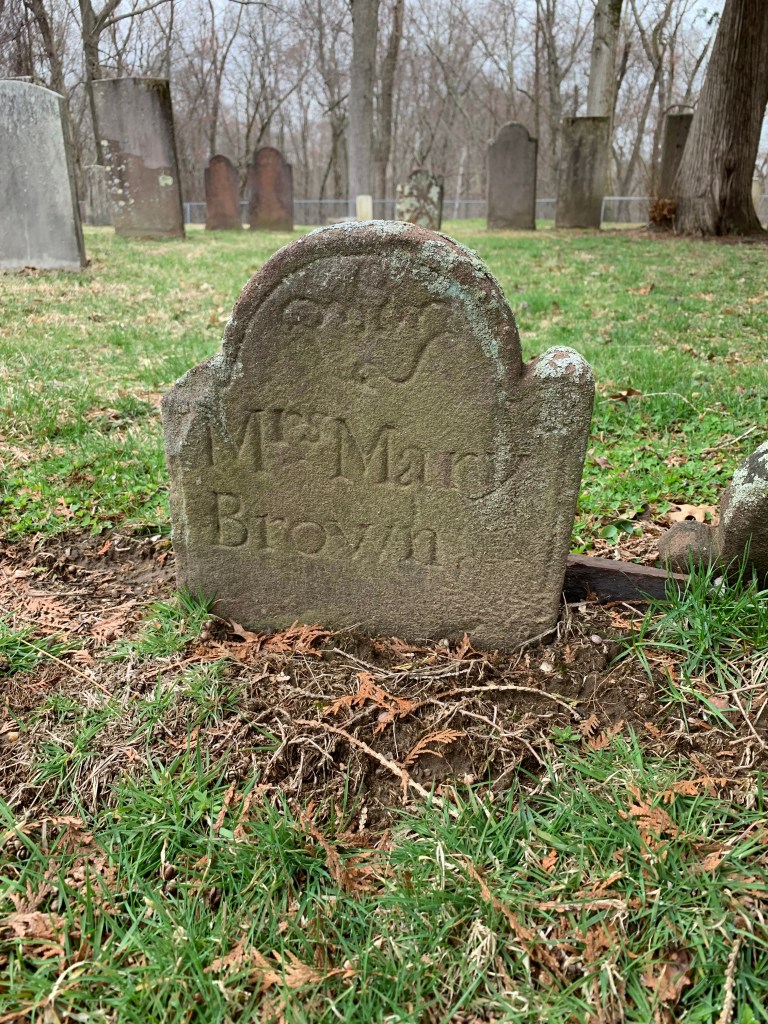
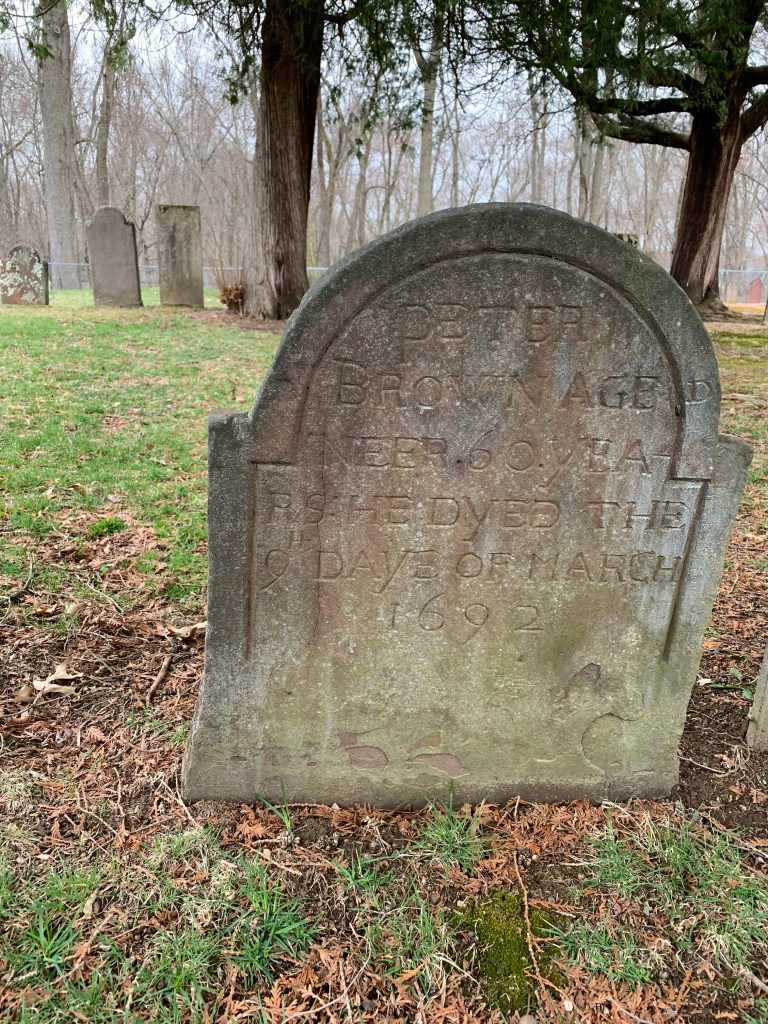
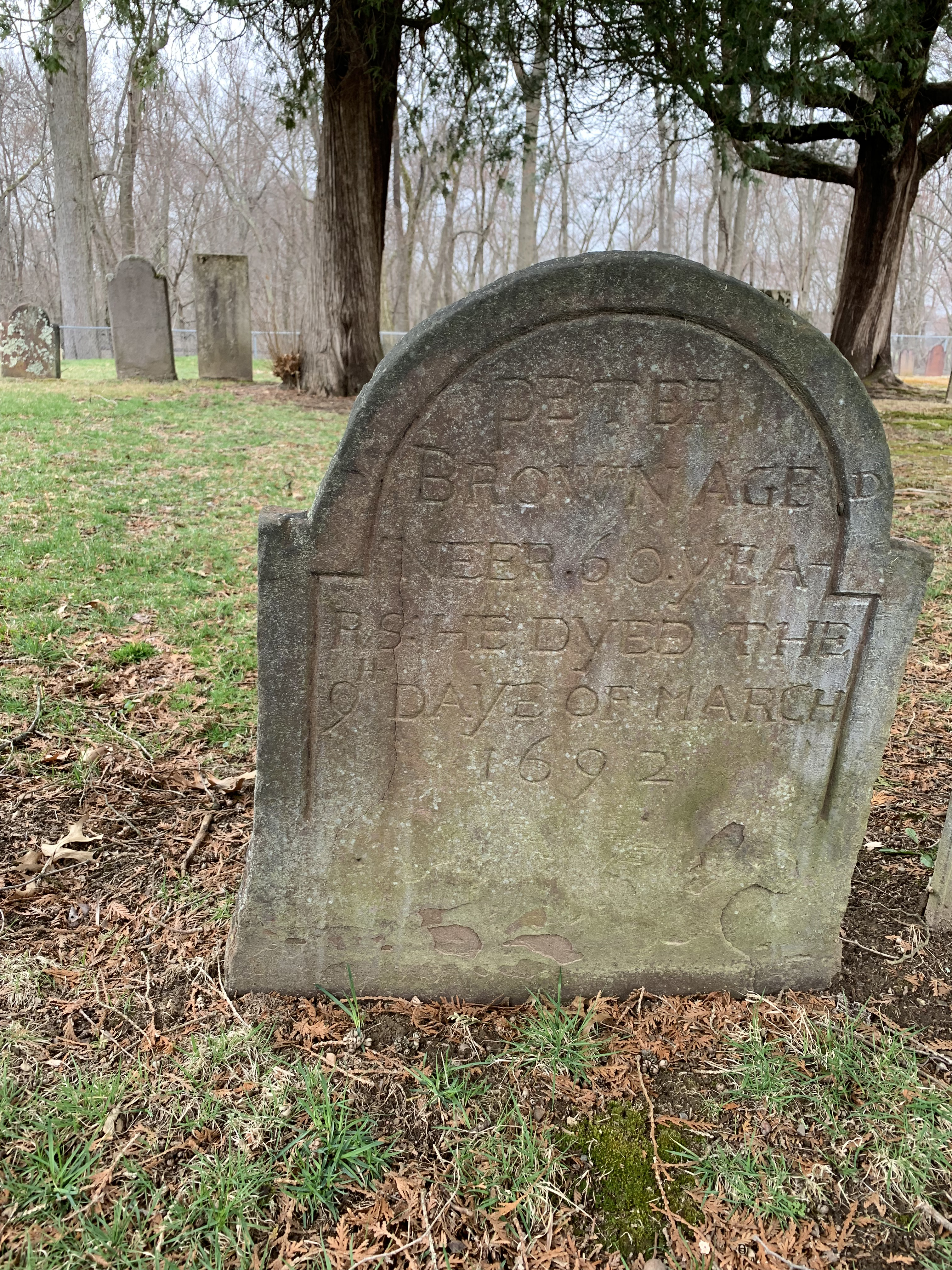
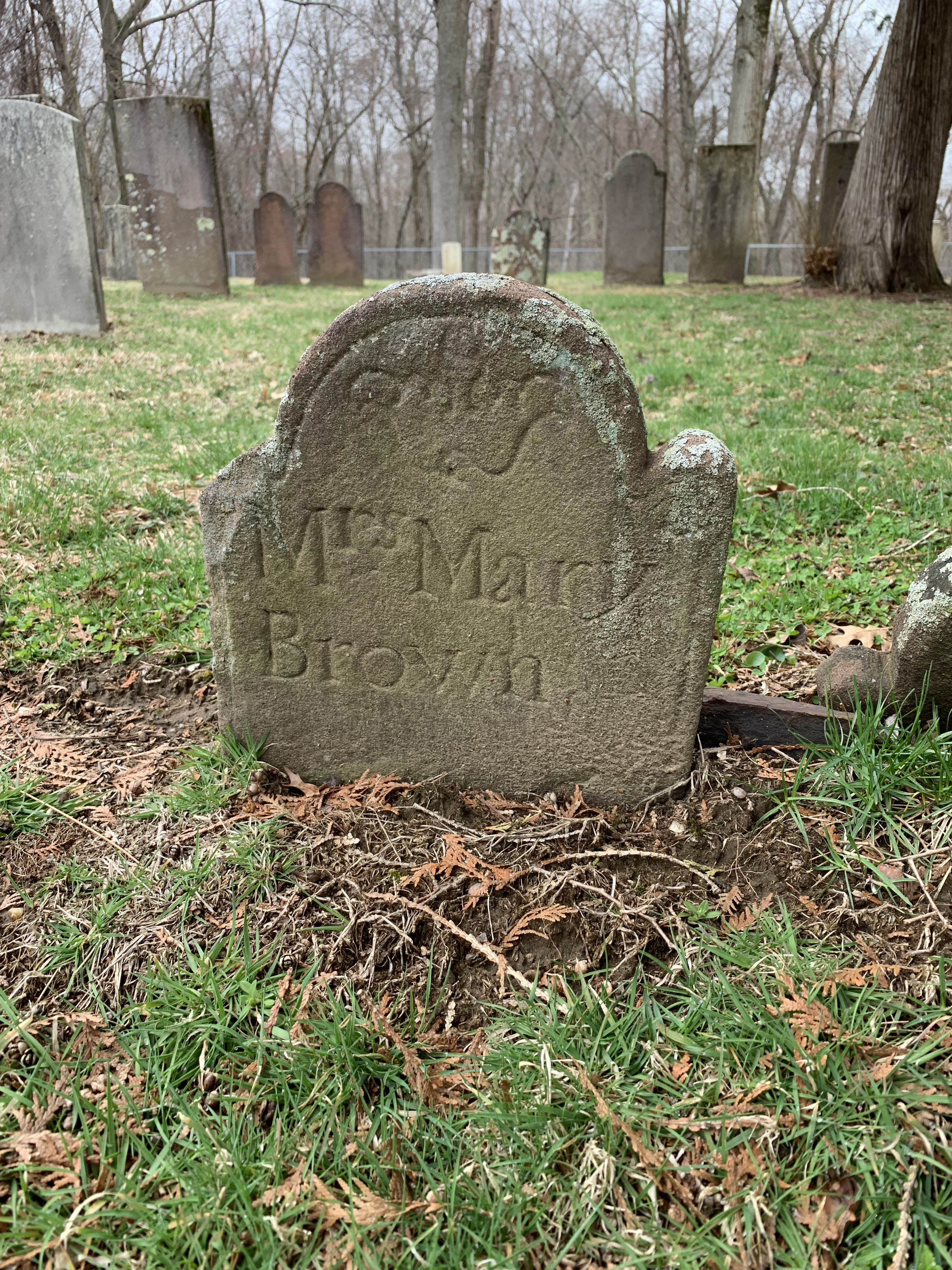
Mary Gillet Brown, first daughter of Jonathan and Mary Dolbere, gravesite in the Windsor cemetery Peter Brown, Mary’s husband. (NOT the Peter Brown of the Mayflower line, per the NEHGS)
In Windsor they bought land, farmed and flourished, founding an incredibly large family tree. According to the modern day Church Historian in Chaffcombe, the Gillette brothers must have populated the entire United States! They see more visitors from the Gillette family every year than any other group of Americans.
While the Gillets (Gillette, Gyllet, Jellet…oh so many ways to spell their name) weren’t the first to come to the New World, they certainly were here early. I’d love to more about what this world looked and felt like when they arrived, wouldn’t you?
My parents Marilyn Hope Johnson and Maurice Earl Ford Jr. met at Fullerton Union High School in Southern California. Marilyn was the first-born daughter of pioneer orange ranchers in Yorba Linda, CA and Maury (or Fordo) was the only son of parents with deep roots in Orange County and in North America. On his father’s side, Maury’s great-grandparents were founders of the City of Placentia in Orange County, as well as being some of the first orange ranchers in the area. His ancestors on his mother’s side landed in Massachusetts in the early 1630s.
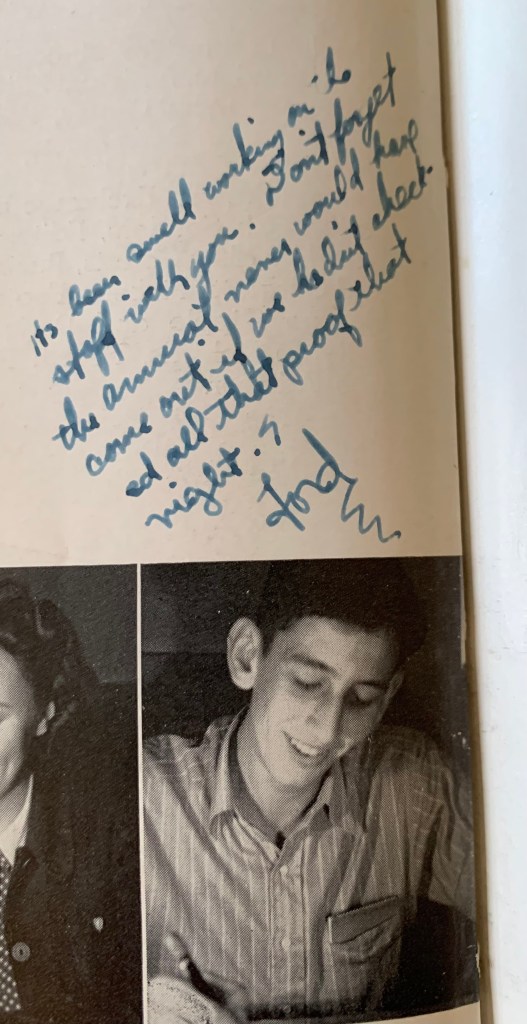
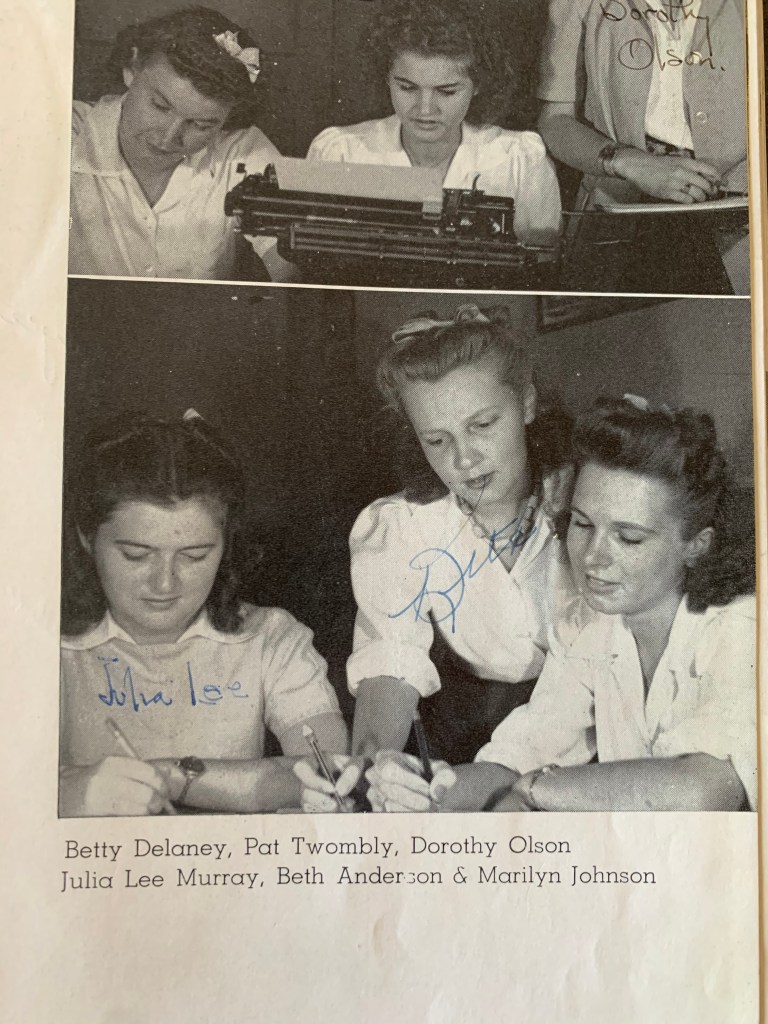
I don’t know exactly when Marilyn and Maury (or Fordo as she affectionately called him) met. However, in her senior yearbook The Pleaides (1941), I found pictures of both of them on the yearbook staff pages. Maury was the Business Manager and Marilyn was an Art Editor. In his inscription to her, he wrote, “It’s been swell working on the staff with you. Don’t forget the annual never would have come out if we hadn’t checked all that proof that night,” signed Ford. We can only imagine what checking all the proof “that night” really meant.
Maury being Business Manager of the Pleaides
Marilyn and the other art editors for the Pleaides
Their actual courtship was relatively short. Like most young men of this era, Maury was called to military service and enlisted on 4 September 1942 in the US Naval Reserve, a short year after their graduation from high school. He became a member of the famed SeaBees and remained in the service until 16 July 1946, when he was released from the New York Naval Shipyard in Brooklyn.
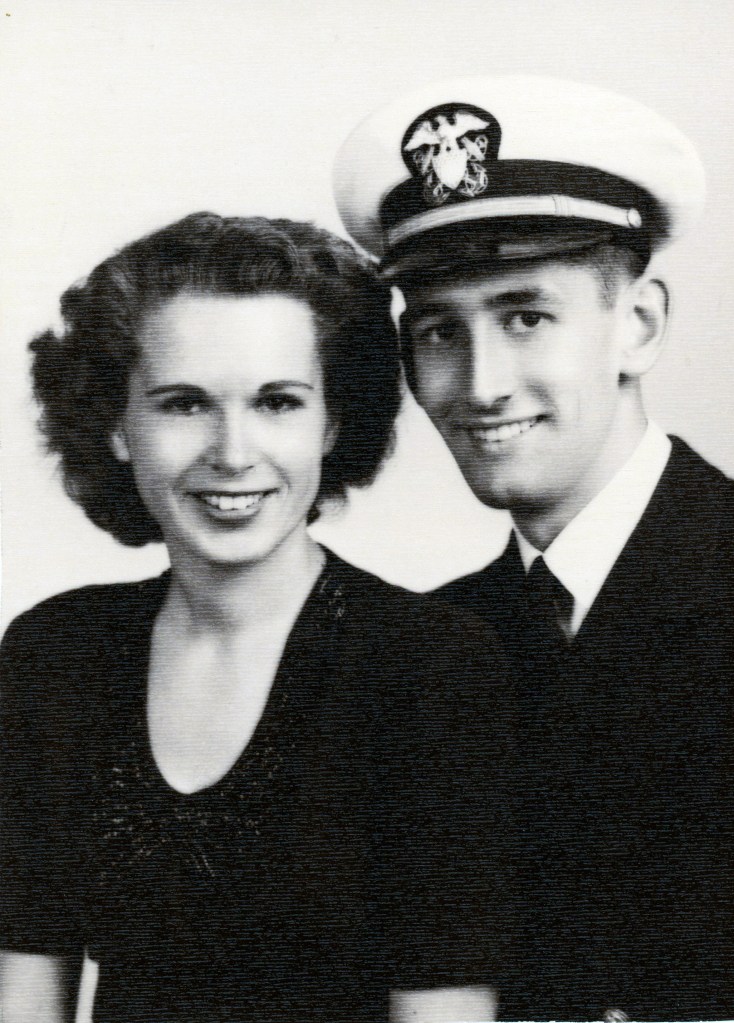
Wedding portrait, Brooklyn NY
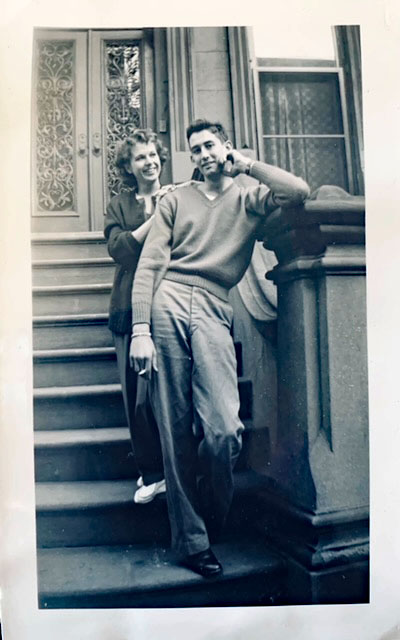
Maury was due to be shipped to the Pacific when the bombs were dropped over Nagasaki and Hiroshima. He always said he wished he’d gone to sea, but it was not to be. Instead he invited Marilyn to come back to New York to get married. She left home, alone and without food for the trip, aboard a train that traveled across the US to Brooklyn. They were married on 22 August 1945, setting up housekeeping in a brownstone in Brooklyn, near the Naval Shipyards. When they returned to California after his discharge, they started their family. Starting in 1947, when I was born, they had six children: me (Marilee), Judy, Gale, Dennis, John and Janis.
Marilyn and Maury on the steps of their brownstone in Brooklyn
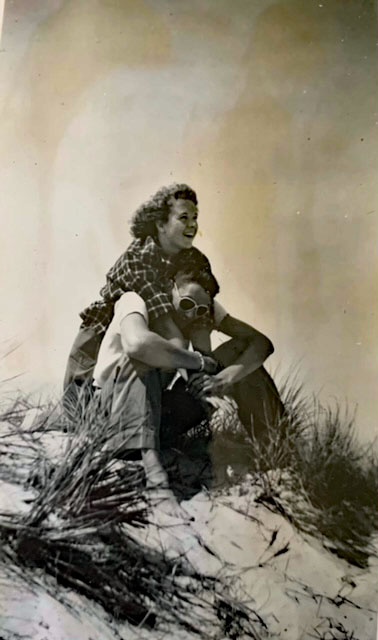
A day at the beach, probably on Long Island
Marilyn and Maury had a long life together. They were married 1 day shy of 50 years, when, on 21 August 1995, Maury passed away from the complications of a stroke. Marilyn lived another 22 years, passing away from old age also on 21 August, but in 2017.
I’ll never forget her last words to him as she leaned over and rested her forehead on his arm, “Oh Fordo”, the two of them surrounded by most of their grown children and a grandson.
I think being a genealogist actually REQUIRES that one be curious. I can think of many fragments of stories I long to know more about. Most especially I wish I’d asked more questions when those who would know the answer were still alive.
When the six of us were helping my mother clean out her house, prior to moving to Assisted Living, each of us were allowed to keep items we were interested in. I, of course, grabbed some pretty random things, sure that they had meaning to our family, even if I didn’t know why. Photo albums were one of those things. And thank goodness, I had them, because they ended up being essential for feeding my curiosity about the things pictured below and the story attached to them.
My mother grew up on an orange ranch planted by her grandparents, Luella May Law Johnson and Charles Roscoe Johnson. The Yorba Linda ranch in Southern California helped to sustain them through depression years, as they were able to trade oranges for goods and services.
Her son Ross Bernard Johnson built a home in 1927, down on the flats next to Ohio Street, one of the first homes in the area to be fully equipped with electrical current throughout. We moved onto the property in 1949 after my grandmother Helen died, and stayed there for several years, first in the apartment over the garage and then in the main house after my grandfather died.
I have many memories of riding around on the tractor in the groves, helping my uncle to feed his rabbits, sitting on the front porch with a new very curly permanented hair-do, and learning to ride my first big bike. Some of my fondest memories were going up the hill with my sister, Judy, to play with Grandma Johnson’s miniature tea set. I loved it there.
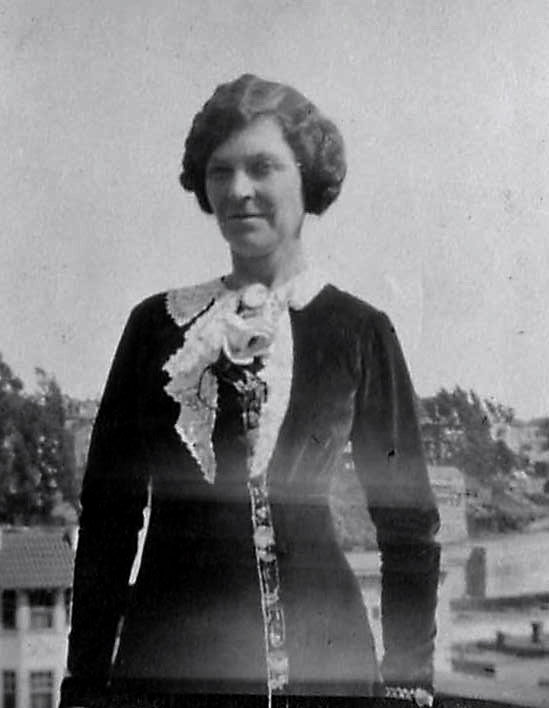
Luella Law Johnsonn
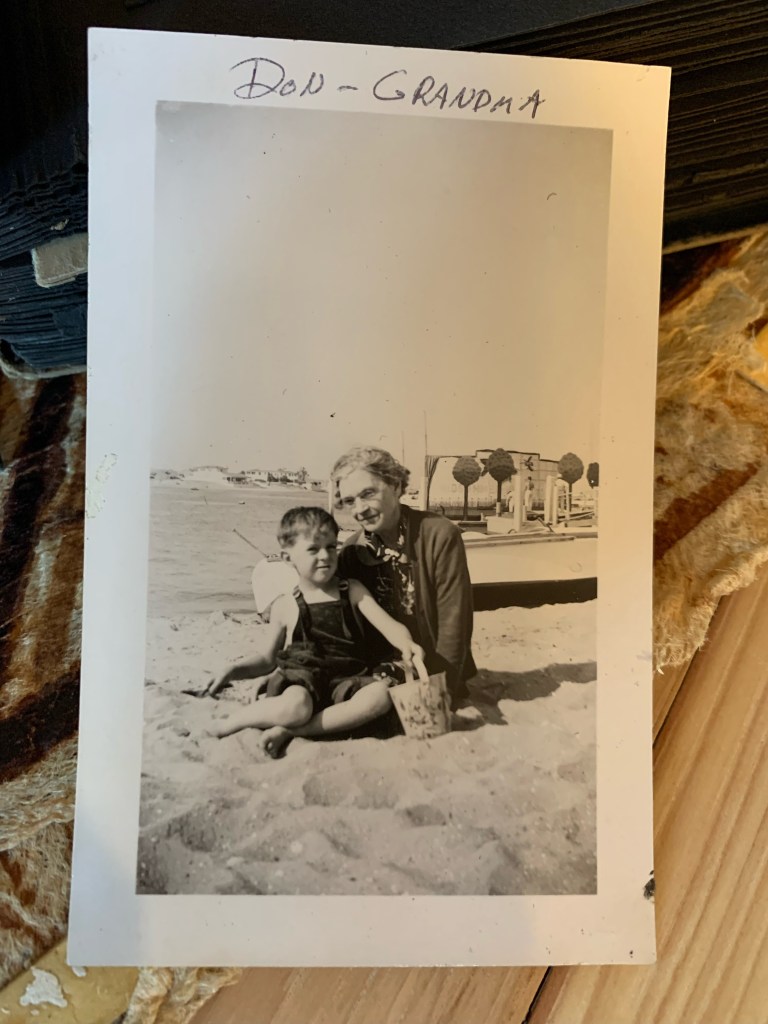
Luella with Grandson Don, my uncle
After her husband died in 1920, Luella continued to live in the house above the orange grove for many years. Luella didn’t stay home, however. She traveled. Sometimes she travelled for the Yorba Linda Chamber of Commerce. Sometimes, she traveled with friends.
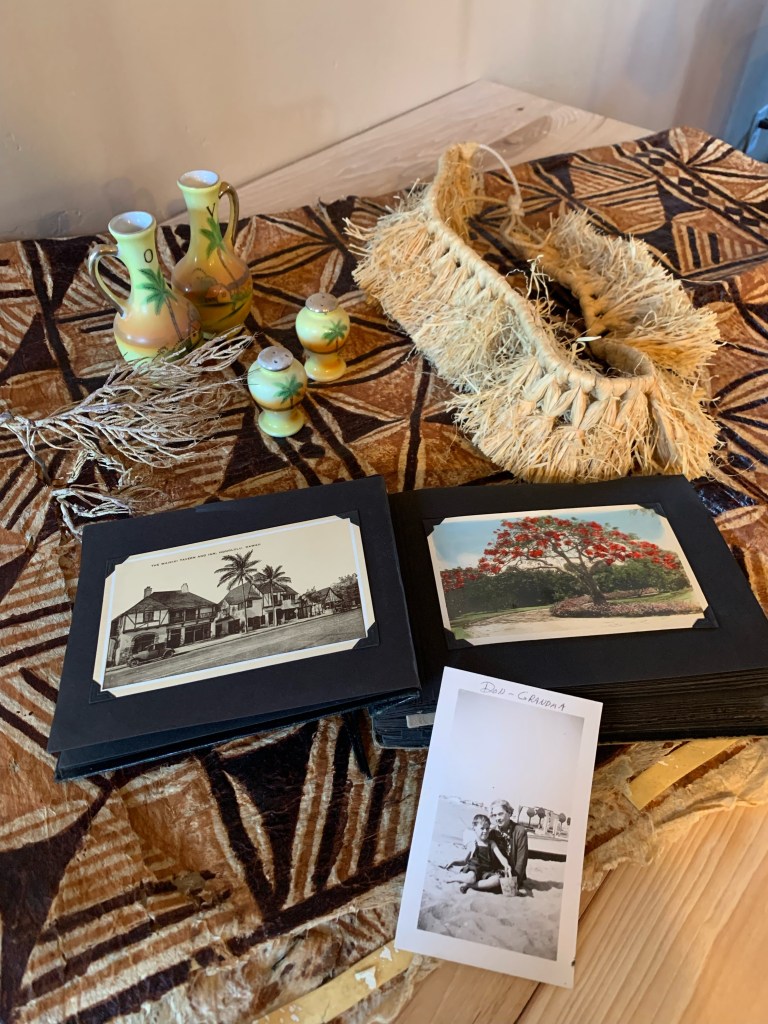
The trip I was curious about must have been significant to her. She filled a small photo album with not only tourist-y photos and postcards (some from 1927), but also pictures of she and her friends learning to surf, sun-bathing on the beach of Waikiki, and having a wonderful time in Honolulu and on the Big Island, where they visited the Kilaueu Volcano. They toured Kauai and took a boat trip to see the leper colony on Molokai.
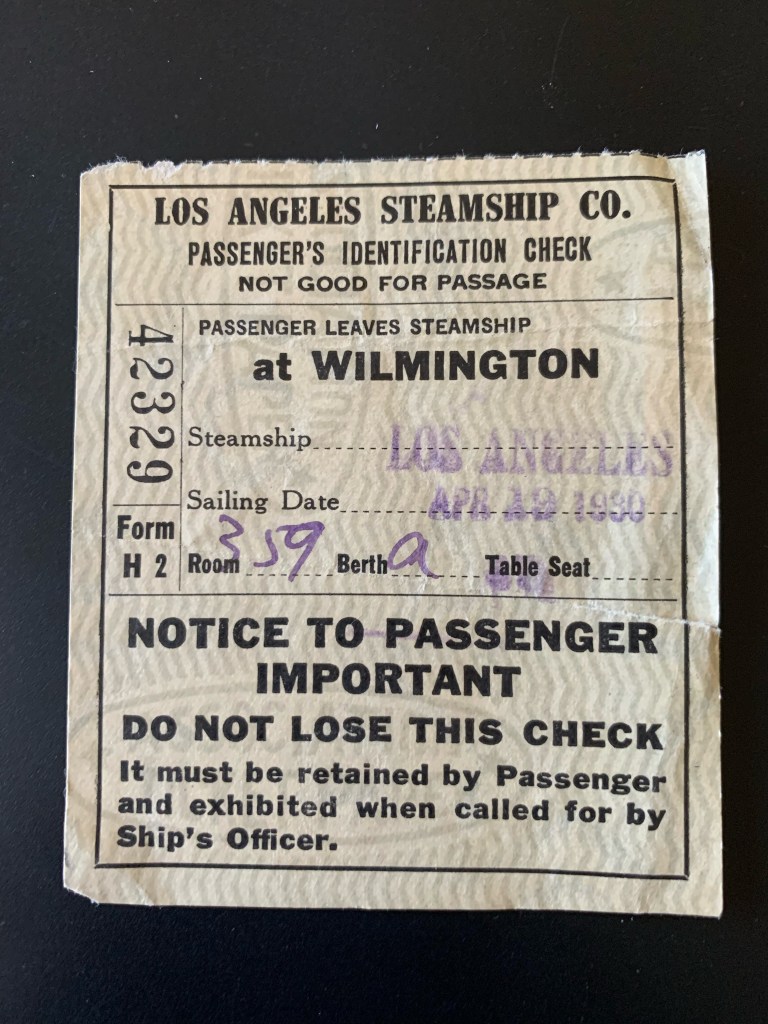
Inside the photo album was also a very small envelope. In it were keepsakes such as more tiny photos, a letter from my mother (then a young girl) telling about her Easter vacation, and a recipe for bean-corn salad. Most interesting was the ticket shown below. I had always believed the album told a story of her travel in the 20’s. Now I know she cruised as a passenger with the Los Angeles Steamship Co. out of Wilmington on April 12, 1930.
My other questions, I may never have the answer to. I want to know the stories behind the objects in the picture below. Were they just tourist shop purchases? Who was the handsome dude (obviously of Hawaiian background) in the album? And on and on…
One last thing. My mother had a copy of a newspaper article written when she returned. She was interviewed about her journey, saying, “Hawaii is a place of contrasts. Snow-capped Mauna Kea looms above, while at the base the warm waters of the Pacific dash against the palm fringed tropic shore. The only sad part of the whole voyage is the leper isle which makes one feel uneasy as the ship glides by the home of those isolated people. That is all they are privileged to see and it reminds me of ‘The Ships that Pass in the Night.” Since Luella became a teacher in 1898, it was fitting that the last paragraph of the interview is about the education and language of the native Hawaiians.
Several of my sisters and brothers love to travel, and just maybe Luella is where we acquired the bug!
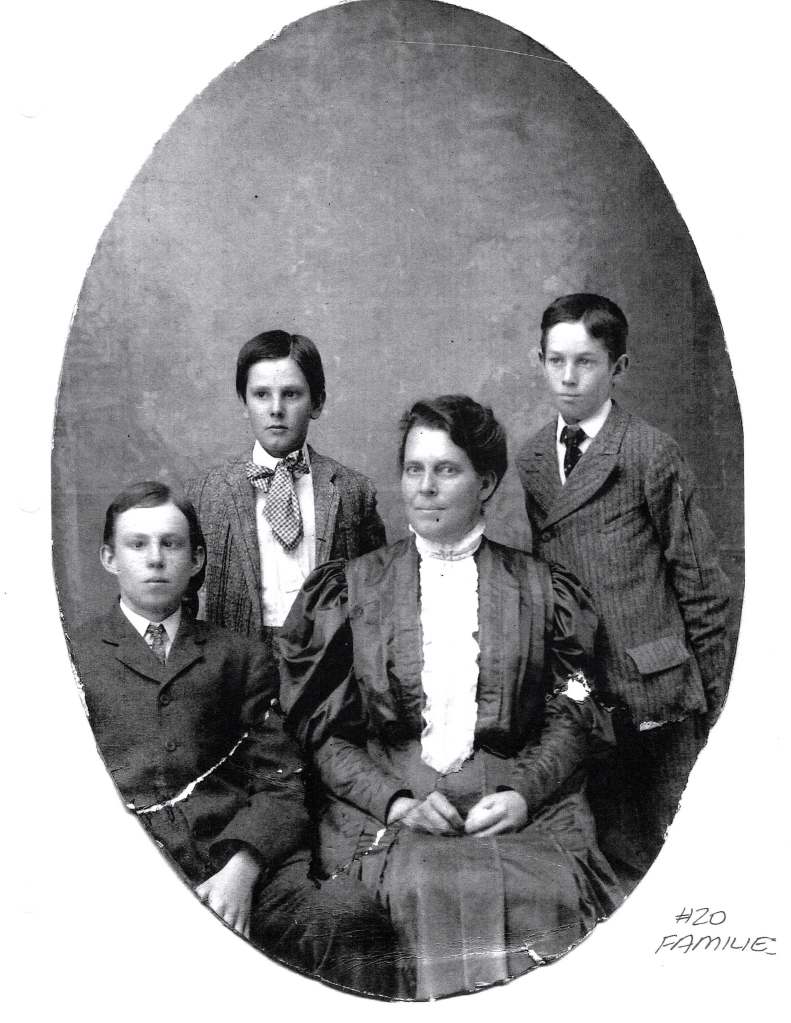
Carrie Earl McFadden Ford with her three sons. (Sons L to R) Herbert Andrew born 27 June 1895, Alvin Leon born 9 Sept 1890, and Maurice Earl (my grandfather) born 14 Jan 1893. Carrie’s Husband Herbert Alvin Ford (pictured in the banner at the top of this page) died 6 June 1895 from Tuberculosis, when she was still pregnant with Herbert Andrew. Becoming a widow at the age of 27, Carrie did not shrink into passive widowhood. “She quickly took control of their ranch and extensive land holdings, establishing herself as a powerful business figure in her own right. during this era, she was the only woman running a ranch in the area.”
One of her many accomplishments was to follow up on a lawsuit filed and won by her husband against an individual who did not deliver on a pre-paid order of orange trees. This man refused to pay the judgement attained against him, so Carrie took her case against him all the way to the California Supreme Court, “establishing the legal right of widows to claims won by their late husbands.” (quotes from Fullerton Heritage, Spring, Volume 17, Number 8, May 11)
My favorite find isn’t a thing. I don’t remember who discovered who first (probably she found me first since she’s the DNA Ace!). But somehow my find and I connected via a DNA match on Ancestry sometime before December 2018, which is when we first met in person. We had multiple e-conversations and a few phone calls prior to that…maybe Carol Anne Johnston Snow will remember exactly when we connected.
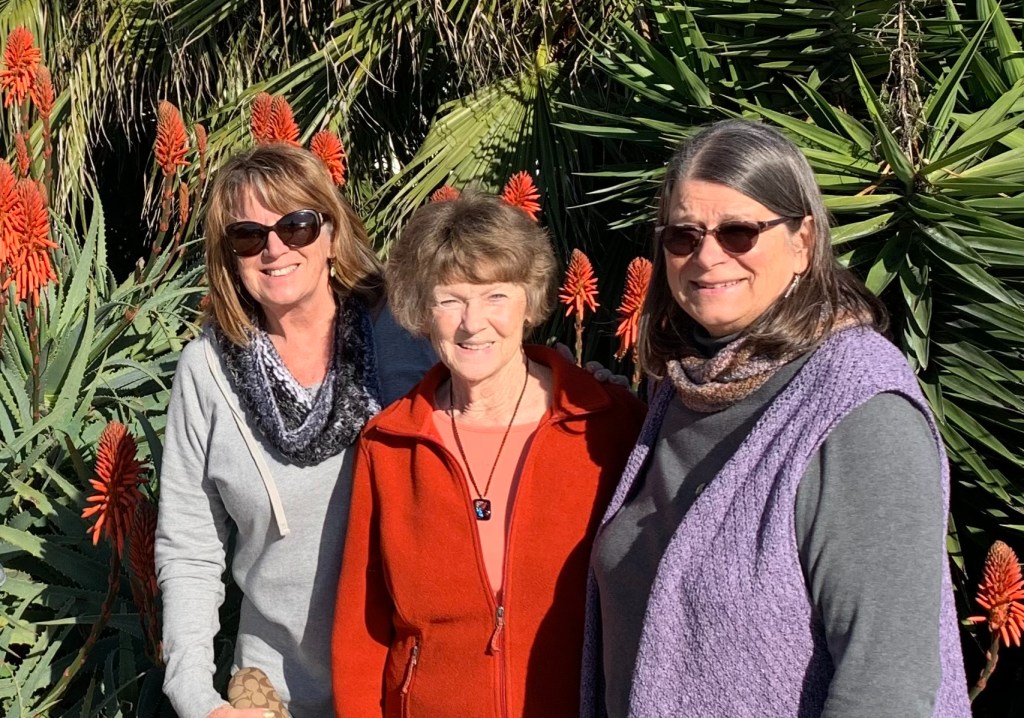
On a beautiful sunny Southern California day in late 2018, my sister Judy and I met Carol in San Clemente for lunch. When she walked up to our table, our jaws dropped. It was like seeing our Aunt Arlene re-appear in the flesh! I will let you see what I mean.
Judy, Carol and Marilee
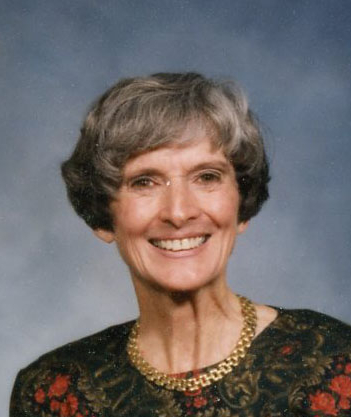
Aunt Arlene
The three Johnson Sibs
Perhaps you can see the striking resemblance! Their resemblance didn’t stop with body build, facial structure, skin tones, and hair. Carol and Arlene also share a similar personality. Like I said it was uncanny. Ancestry lists their relationship as third cousins once removed, but Judy and I swore they could have been sisters!
The siblings (Don, Marilyn and Arlene) are all gone now. I wish they could have all met Carol, who only lived about 60 miles away from where my mother was born and raised and lived out her life.
That said, I’m fortunate to have Carol as a genealogy buddy. We work together primarily on the Johns(t)on(e) family line. The reason for all of the parenthesis is related to a name change and is the reason that our Johnson line (our mother’s family) had no idea Carol’s line (Johnston) existed.
In the generation of Carol’s and my mom’s great grandfathers, there was a name change for some of the ten offspring of Stephen Johnson and Abigail Cobbey. Our family line remained Johnson. Carol’s family line changed their last name to Johnston. Other brothers changed their name to Johnstone. Some stories that Carol has collected say that Johnston was closer to the original family name. But it also meant that when my mother was researching her great-grandfather (pre-internet and DNA) she never found the Johnston line.
The family first shows up in Ross and Miami Counties in Ohio in the 1830s. Some census forms indicate that Stephen Johnson came from Virginia. Sounds like good information, right? We are here to tell you that there are a lot of Stephen Johnsons in Virginia and Ohio. That very real fact makes for a genealogical nightmare.
Carol and I are still working on getting further back on Stephen’s line, as we have been from the beginning of our relationship. I tend to focus on the story, researching things that fill out the world around our ancestors. Carol does that too, but she’s really a DNA whiz kid, so that’s what she typically revisits first, when we pick up the Johns(t)on search again.
What an incredibly special FIND for my entire family! Now I’m off to research the agricultural schedules for evidence of our farming Johns(t)on(e)s and Carol will revisit all of our DNA matches for new evidence. May the force be with us.
PS: Here’s Carol’s response to my post. Some of the detail can only be appreciated in all of its wonder, if you’re a GERD like we are! (Genealogy NERD)
“Truth be told, your post is SO wonderful and enthusiastic that I really don’t want to get deeply into edits or revisions. However, you sent me off on an interesting goose chase this afternoon, and I will comment on a few things.”
“I’ve been re-reading messages on the Ancestry system which go back to April 2009. It was I who FIRST contacted you on the system on June 24, 2014. At that point (actually, since 1969) I’d known about your great grandfather, but not too much beyond him. Both of our branches had men die young, and that AND geography might have contributed to the lack of branches staying in touch. It was only through my grandfather Sterling Johnston’s correspondence with other branches (Alaska, Utah, etc.) that I had considerable starting material, which didn’t come to me until 1969 (a number of years after my grandfather’s death in 1961). And when I saw your tree on Ancestry, I was sure we were related and we pieced things together after that, each of extending the other’s information!”
“By 2017 we were writing about DNA–and did the Y testing for my nephew and your uncle. That of course has lead us down some rabbit holes.”
“We first met IN PERSON when I took the bus from SF to Petaluma and stayed overnight–October 4-5, 2018. And YES, on December 28, 2018, there was the wonderful lunch in San Clemente with Judy joining us!!”
“Johnstone was reportedly the original family name and has been used exclusively by the Alaskan branch FOREVER. That’s where Jenny fits in (and I was first in touch with HER in 1970 though I didn’t meet her until my first trip to Alaska in 2011, and on other trips since then).”
“Bottom line–you are the FIND in my genealogy world! It seems ironic that you are a few years younger, but a generation removed!”
The genealogist Amy Johnson Crow has invited her blog followers to join her in 2022 for “The 52 Ancestors in 52 Weeks” challenge. It’s a low-stress opportunity to make something from all of the research we do in genealogy. For me that research tends to accumulate in binders, boxes of papers, in computer files and amongst the flotsam and jetsam of my genealogy world. I actually started this Following the Trails blog to share what I’ve learned, but, if it isn’t obvious by now, I need a prompt to keep it up. So, for better or worse, I’m trying Amy’s challenge as a way to share the stories I’ve accumulated over the years.
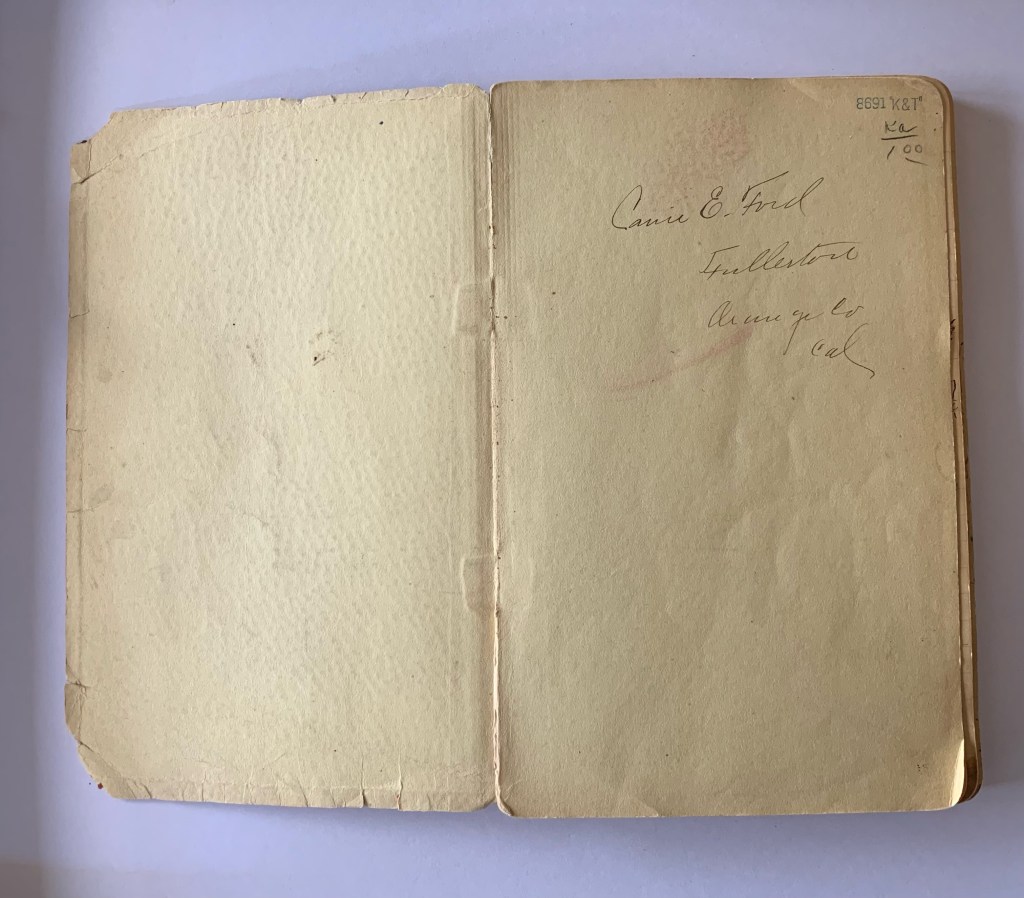
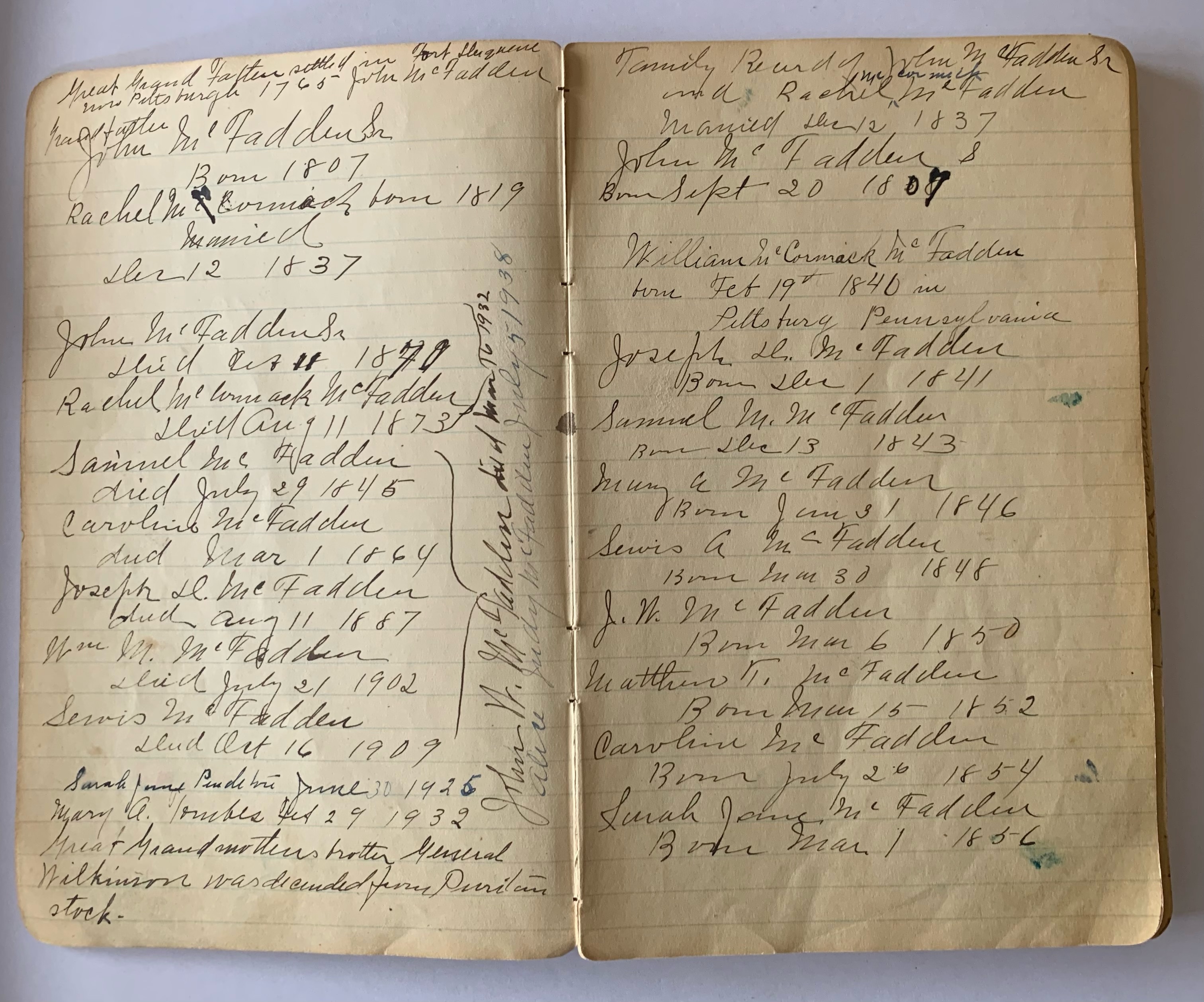
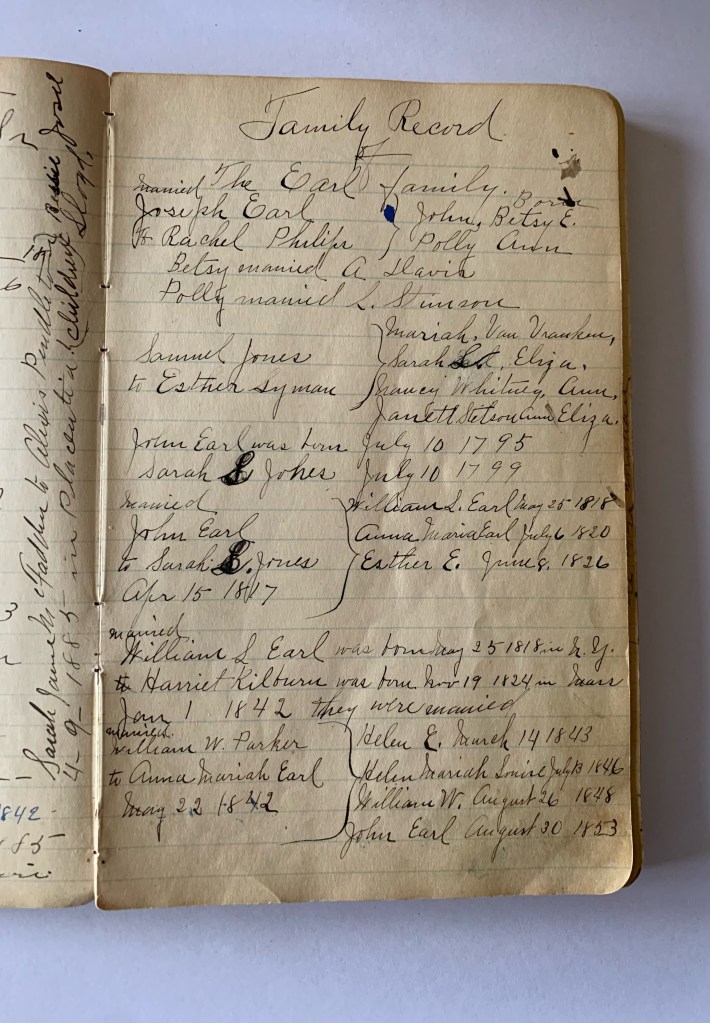
The subject of the first week is FOUNDATIONS. My immediate reaction is to think of this little book with information compiled by my great grandmother Carrie McFadden Ford. The book consists of the types of information you’d typically find in a family bible. Births, marriages and death dates along with snippets here and there of where these ancestors lived and for how long and how they got to where they ended up. GOLD for a genealogist!
Various people in the family have perused this book, looking for information. I can see notes in handwriting I recognize, like my mother Marilyn Ford, but most of it is written by Carrie herself. The last identifiable entry from her is for an event in 1949. Given the state of her handwriting at the time the entry was written, I’m thinking she wrote it closer to her death in 1961.
No doubt part of the information was compiled to qualify her for membership in the DAR (she was a charter member of the Mojave Chapter). But that’s another rabbit hole for me to go down another day.
As an aside, Carrie was described as “one of Fullerton’s most philanthropic residents.” A full description of her history, her numerous activities and accomplishments can be found in the Fullerton Heritage (Spring, Volume 17, No.2, May 2011). How she managed to do all that, raise four boys on her own, as well as become the matriarch of the family after her parent’s death…well let’s just say, I’m in awe.
Carrie was understandably proud of her heritage, which she traced back to the earliest days of European settlements in the continental US. She researched four primary family lines. What follows are a few of the pages she wrote.
The McCormack family, most often spelled McCormick. Rachel married John McFadden, Carrie’s grandfather.
The McFadden family. Carrie’s father was William McCormick McFadden, one of the earliest settlers in what became Orange County.
The Earl family. Carrie’s mother was Sarah Jane Earl. The Earl family was the line Carrie used to trace her ancestors back to the Revolutionary War (Phineas Fairbanks), to qualify for DAR.
And last but not least, she researched the Ford family. She was also able to trace this family line back to the early days of the Republic. Originally my sisters and I thought this was her DAR qualifier (Benoni Ford), but since it was her husband’s family, it could not be a direct line. My sister Judy and I discovered this when we visited the New England Historical Genealogical Society in 2019.
So yes, FOUNDATIONS. I’m blessed with a firm foundation on which to build my genealogy research. Thank you Carrie!
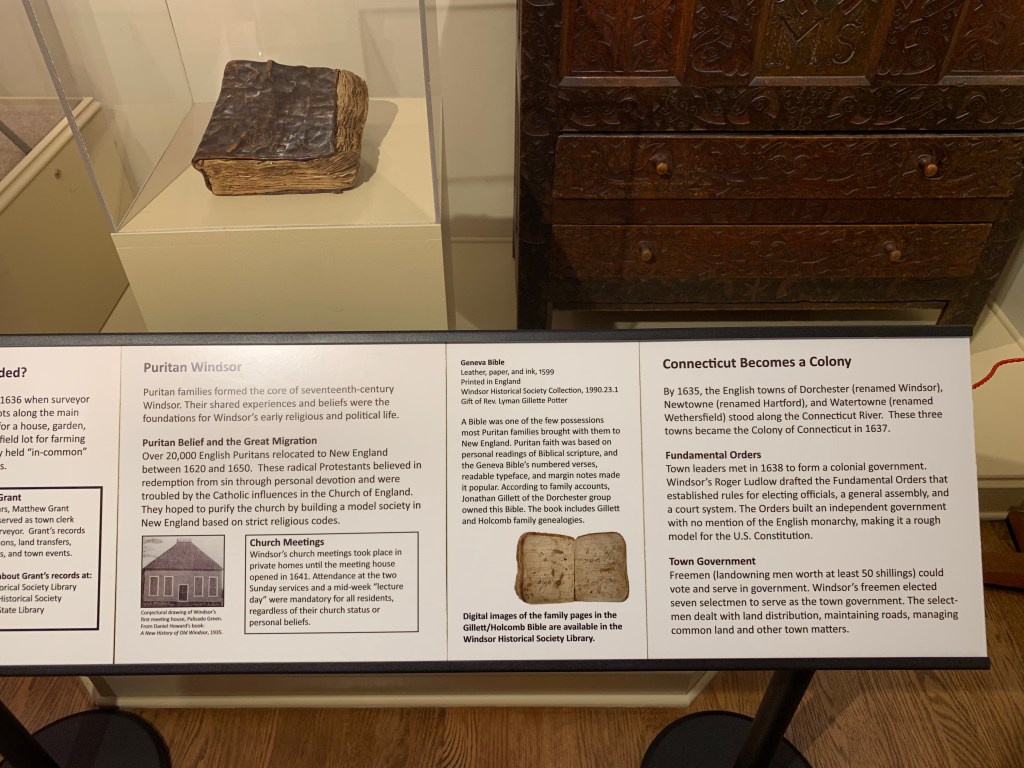
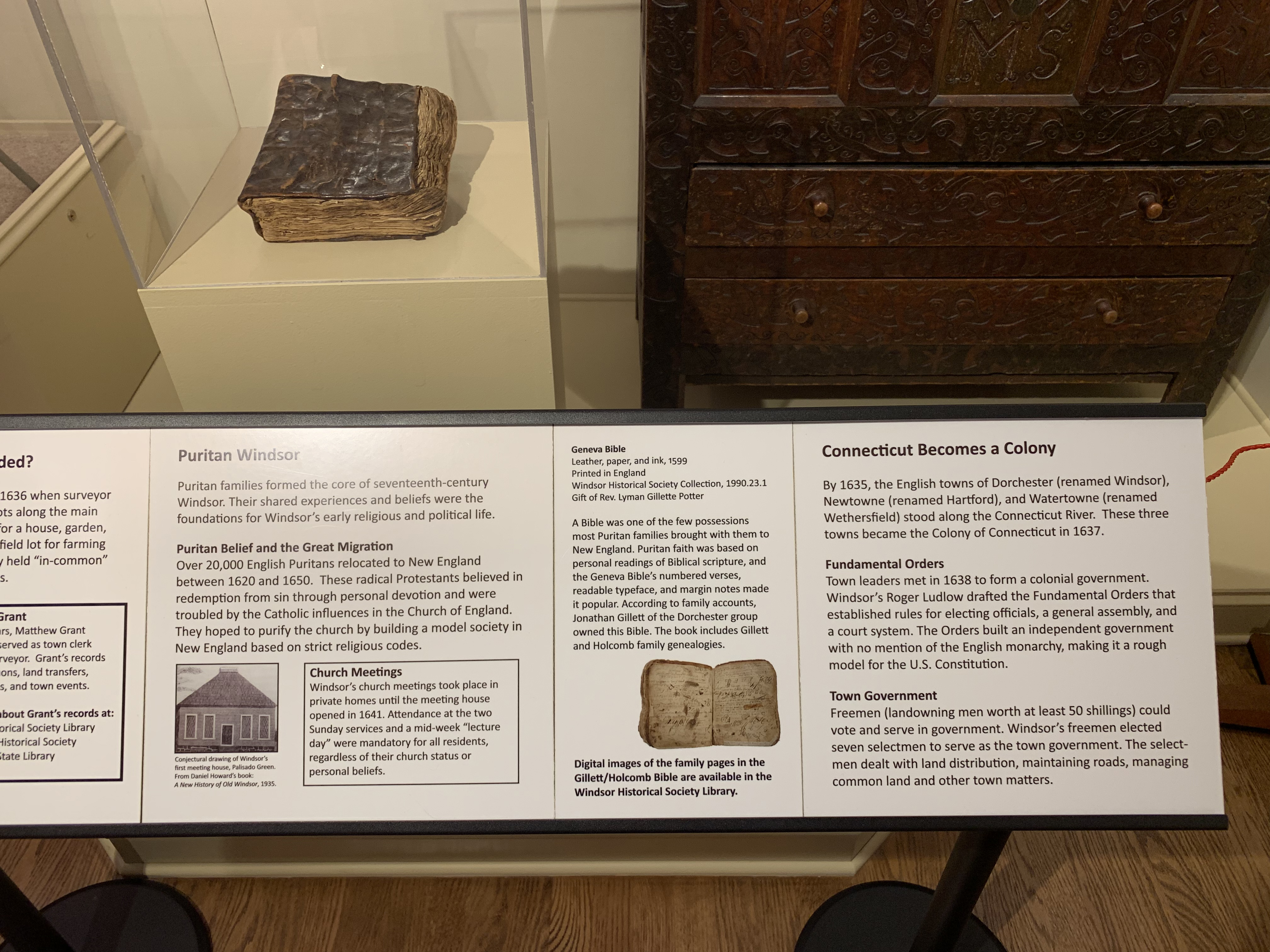
The Bear Bible on display at the Windsor Historical Society
My activities with regards to our genealogic history wax and wane with the seasons. It’s been gardening and canning season, so my days are otherwise occupied. Then there’s the generalized unsettled feeling of this pandemic. Nuf’ said.
In following up with the church in England where the Gillette’s came from, I was directed to a man named Stephen Taylor. Following is my correspondence with him. I hope you find it interesting. He has very definite opinions about the story about the Bear Bible, and it might not be what you expect.
Just FYI: this is an example of an actual fruitful genealogy inquiry. There are many more attempts that I have made over the years that have resulted in little or no response. Said in another way, this is a true genealogy gem!
March 12, 2021
Dear Mr. Taylor.
I got your name from Jean Liddiatt when I sent the following inquiry.
My name is Marilee Ford. I am a descendant of a man I believe to have been the pastor at the church in Chaffcombe in the 1600s, who died there in 1641. His name was Rev. William Gylett. Two of his sons, Nathan and Jonathan emigrated to the United States in 1634. Jonathan started the line of Gillette’s that I am related to.
My husband and I came to Chaffcombe on our way to Wales a few years ago (before Co-vid!). The church was very quiet, but I have been meaning to contact you since then to find out if you have a church historian or someone who is familiar with any old records or stories of the Gyletts that may still exist. Could you possibly tell who I might contact for that information?
I do appreciate that this was a very long time ago, and would be grateful for any assistance you might be able to give me.
Warm wishes for your health and safety.
Marilee Ford (my grandmother was a Gillette, as the name came to be in the US)
March 14, 2021
Hello…your enquiry about Rev. Gillet has been passed to me as a retired academic church architectural historian, and long-term resident of Chaffcombe. (Came here 1946) Unfortunately there are to my knowledge no stories or records extant of Rev. Gillet’s time as Rector of Chaffcombe, other than the dates of his incumbency. All that we know is that his sons must have been assiduous in fulfilling the biblical injunction to “be fruitful and multiply”……..we have more visitors from his American descendants than from all other emigrant families put together! The church building has substantially changed since his time….he would probably recognize the tower (c. 1500) and perhaps parts of the chancel, but the main body of the building was entirely reconstructed in the 19th century, and if there were any earlier memorial tablets, they have not survived. Nor is there any stained glass of pre-19th century date. There is however an Elizabethan silver communion cup and cover which he must have used, and which is still in use. And the communion table now in the Lady Chapel may have been in use in his time as the main Holy Table or altar in the chancel. Also there is the mediaeval former rectory house in the village……if he was indeed resident (and in those times a lot of incumbents were non-resident) that is where he would have lived.. More than this, there is nothing that I can tell…..there is an early baptismal register. on vellum, but I do not think it goes back to his time. I consulted it long ago when it was still kept in the church, and have forgotten the exact dates….. a recent incumbent consigned it to the Bath & Wells Diocesan archives, which I think are now held by the Somerset County Record Office in Taunton. But there was, as I recall, nothing in there about the incumbents. Sorry that the material is so sparse!
Happy Days!
Steven Taylor
Dear Mr. Taylor Thank you so much for your complete response. One request would be if you could confirm the dates he was rector at your parish. I’d appreciate it. You’re right…the Gillettes are more than numerous in the US. I had no idea until I went to Windsor Connecticut where they first settled. Have you heard the story of their Bear Bible? The Bible they brought from England still exists. It was at one time used as a stop for the kitchen window and a bear came along and swiped it leaving its claw marks on the pages. It was given to the Windsor Historical Society where it is enshrined in their museum. So part of Chaffcombe is here. I would be happy to furnish the link to the full story if you’d like. Be well. Be safe. Thank you again
Marilee Ford
March 21, 2021
Well, Mrs Ford…..I must apologize for the delay in reply to your last mail, but have been away from home without my computer… I do not know the dates “off the top of my head”, but will find out and let you know as soon as I can.I would be very interested in the link to the bear story…….are they sure that it was a bear, and not the Devil?
Greetings, Steven Taylor
April 2, 2021
Hi Mr. Taylor. I have attached the link to the Bear Bible Story. Hope you enjoy it.
If you can confirm the service of the Gillette Pastor’s time there in Chaffcombe, it would be appreciated. Also if you can confirm he was buried there that would be helpful. I did run across a note in an old history that there was a William Gillette who emigrated to the colonies after these two, Jonathan and Nathan, came…Am wondering if it was a brother or their father. So much conflicting information!
Thanks again for your support.
Marilee Ford
April 3, 2021
Well, Mrs Ford…..thank you for the “bear” story. I was very interested to see that the bible concerned was the Geneva version, a more protestant translation than the 1611 “Authorized Version”, and the one which was popular with the “Puritan” party in England at that period…..leading me to think that the emigrating Gilletts were of that persuasion…..along with many others who went to America at this theologically turbulent time. I still suggest that the “bear” may well have been the Prince of Darkness, who could of course have appeared in any form that He might have wished….and had a tendency to do so to those of radical protestant persuasion!!I have not forgotten your request for the dates of Rev, Gillett’s incumbency, but we are living through bizarrely strange times here….the church where the information lies is locked, and I have yet to encounter the key-holder….. will report as soon as possible.To the best of my knowledge there is no record of Rev. Gillett’s place of burial ….in fact all that we in Chaffcombe know of him is that he seems to have single-handedly (?) populated white America with a multitude of descendants….who all come here as visitors,… and are always welcome….!! The incumbents, then as now, were seldom from local families, so of Rev. Gillett’s antecedents we know nothing…..Sorry to be so negative!
Happy Days…
Steven Taylor
No worries Stephen. The fact that we are in abnormal times is also why I have the time to pursue these endless questions of you! Thanks again
Marilee
April 13, 2021
Well, Marilee…..I have consulted the list of former rectors of Chaffcombe, and Rev Gillet, (there under the Christian name of Edward), was inducted to the incumbency on 4 February 1609. He must have left the scene by 24 March 1642, when his successor Peter Cox was formally inducted.I also noticed that we have had another Gillett (sic) incumbent, George Gabriel Scott Gillett, who was inducted on 12 November 1935. Perhaps he was another of the same tribe? Whatever, he resigned the living after about 4 years, and from chance remarks by his successor Philip Preston, (who was a great friend of mine until his death), was not particularly happy or successful here. Apparently when Rev. Preston took over, the edge of the lawn in front of the rectory house had a retaining border not of tiles, but of empty gin bottles!!Have thought further about the “bear”, and am convinced that it was seen at the time as a Satanic threat….this is not just ignorant speculation on my part, as I have university qualifications in both history and theology, and used to lecture on both subjects….. There must have been lots of bits of wood about suitable for jamming windows, rather than using the Holy Scriptures!!
Happy Days! Steven Taylor
Hi Stephen…Thanks so much for this…food for the endless genealogy fodder. I spend many days down that rabbit hole.
You know, I was always curious about why a BIBLE would have been used as a window stop. You’re right, why not something else. Are you implying that this particular bible was seen as satanically cursed prior to putting it in the window? I’d be interested more in your thoughts on this, given your background in history and theology.
I am a trained nurse, but have always loved history, so genealogy fits that bill. Theology as well fascinates me. Appreciate your insights.
Stay well!
Marilee
April 19, 2021
Well, Marilee, here in outline is my view of the “bear” story….The Geneva Bible was translated by a largely Calvinist group of scholars (though incorporating much material from earlier vernacular versions) and was provided with copious ultra-protestant marginal notes and commentary. It was the favoured translation in the English church through the later part of the reign of Elizabeth 1st, when Calvinist “puritanism” was dominant.. The translators of the 1611 Authorized (King James) version, though again using much from earlier translations, were less dominated by Calvinist theology. The Geneva marginal notes and commentary were removed. The Geneva version remained the favoured version for radical Protestants, but in the established Church of England it was soon supplanted by the version of1611. Large numbers of those who emigrated from here to America in the earlier 17th century were radical Protestants seeeking to escape from what they saw as the insufficiently reformed position of the English church, and the Geneva version would have been the version used by them. While I know nothing of the theological position of Rev. Gillet, I suspect that the emigrants from his family would have travelled for such theological reasons. Such people favoured a strongly literal approach to the Scriptures. Also the printed Bible, as the physical manifestation of the Word of God, was regarded with deep reverence….it would have been seen as utterly sacreligious to use the Bible as a window prop to repel bears. BUT the very presence of the Bible had a great spiritual power, and it would have been a potent weapon in repelling Satanic attacks, in exactly the same way as a follower of the Catholic persuasion would use the Sign of the Cross, or Holy Water. So, far from being Satanically cursed, this Bible was the most powerful weapon available against Satan. This, of course, entirely begs the question of whether the attacker was indeed just a bear, or Satan in disguise….who, you may remember, “as a roaring lion walketh about, seeking whom he may devoure” And if a lion, why not a bear, or any fierce animal?What really matters is what the people at the time thought they were confronting. The evidence points to Satan in disguise.
Enjoy your Alice life down that rabbit hole…. Happy Days!
Hi Stephen.
Fascinating! Do you mind if I share this with the Windsor Historical Society, where the Bear Bible is on display in their museum? It would definitely add to their story.
The only other thought I’d had about these Gillette brothers is that they came to America because they weren’t first or second in line and wouldn’t inherit property or profession…but now that I think of it, in William’s will, I believe, it stated that he had purchased property from Nathan…so probably your religious reason for their emigration makes more sense! Where is our time travel pod when we need it!
Thanks again.
Marilee
April 23, 2021
Well, Marilee…..feel free to share my suggestions with the Bear Society People if you wish……the response, I suspect, will be negative!!
Happy Days…Steven Taylor
September 11, 2021
And that is, in fact, what I did today. Better late than never!
One of the other advantages to the discoveries that came along after jumping into our genealogy rabbit hole was finding out that from the Gillette side of the family, there is a creditable line of musicians, both amateur and professional.
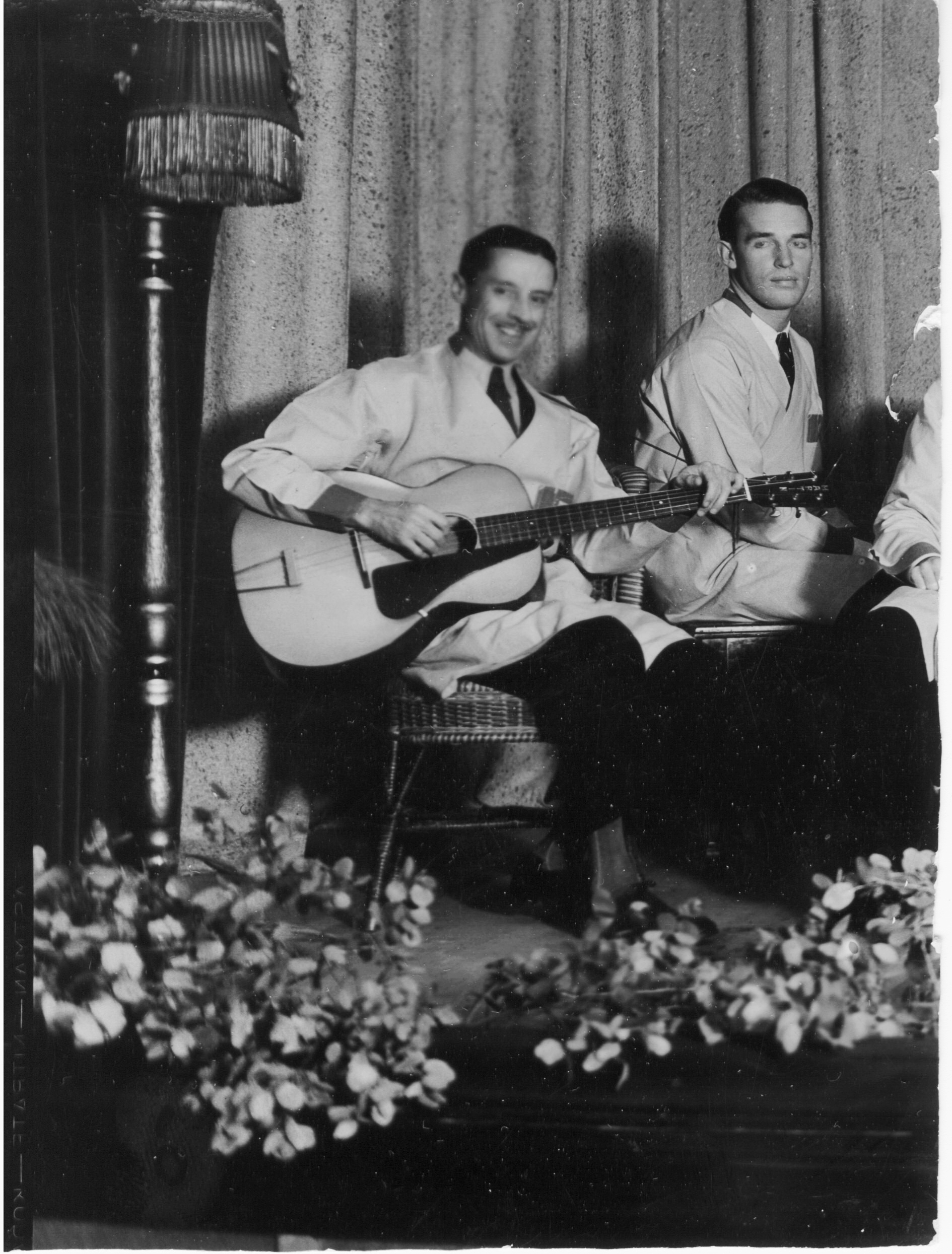
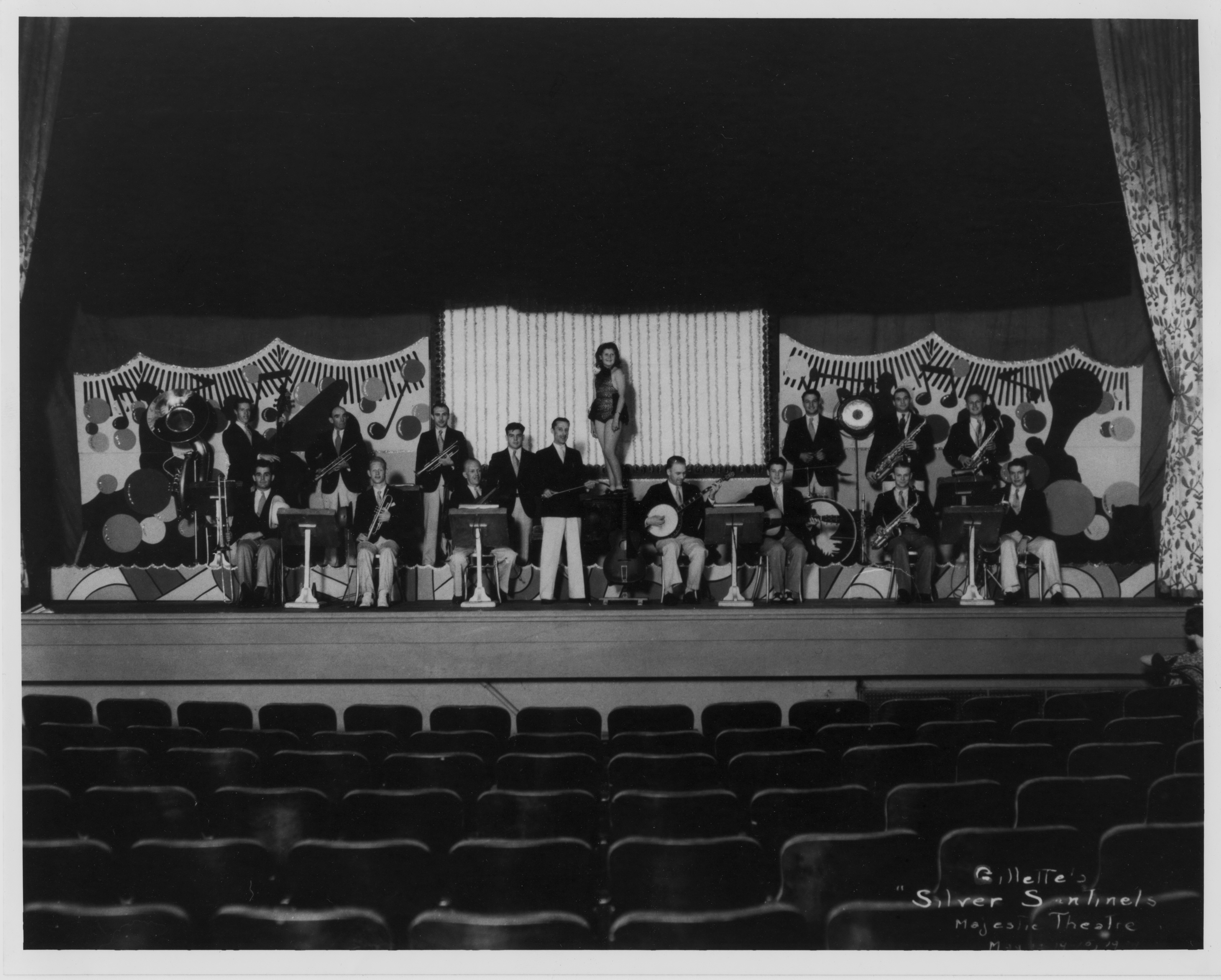
I studied the piano and organ for 12 years, and kept playing until a few years ago. My brother is a DJ at KX 93.5 FM in Laguna Beach, and regularly plays the guitar in bands around Orange County. I vaguely knew that my cousin Jack Forsha (second cousin) was a musician (more later). My grandmother Margaret Morris Gillette played the piano for silent movies. But what I didn’t know is that my grandmother’s brother Thomas Gillette was a big band leader in the Salt Lake City area.
Through Ancestry.com I have become e-acquainted with Thomas’ grandson Chris, who lives in Montana. He has shared several pictures of Thomas, who was a pretty handsome dude.
Thomas Gillette, 1932 (with guitar)The Gillette Silver Sentinels Band in the Majestic Theater, probably Salt Lake City
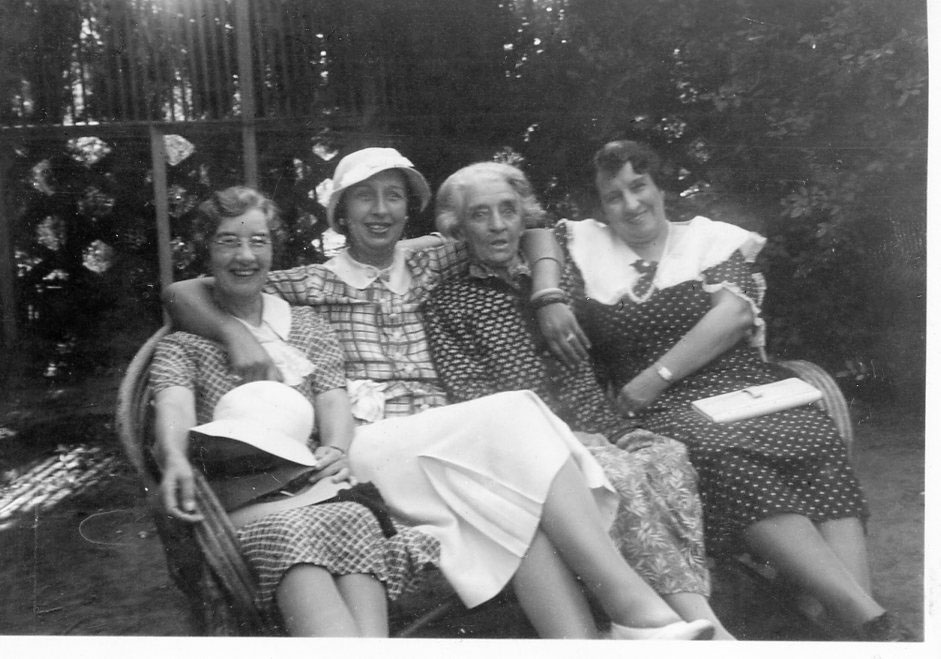
What stimulated my interest in this musical connection was Ancestry letting me know that Aunt Daisy Gillette (my great aunt) was born 141 years ago today, June 23. She was my grandmother’s older sister. They were close, moving with their family from Salt Lake City to Pasadena, CA in the 1920s. We grew up visiting Aunt Daisy who was shorter than my grandmother, and just the sweetest person. My sister and I loved her. She never left Pasadena, marrying her husband John Forsha. Their only son was John G. “Jack” Forsha.
Daisy Gillette Forsha, Margaret Gillette Ford, Mary Ann Morris Gillette, Birdie Gillette Perlywitz
So John G. or Jack, as we knew him, was he really a musician? Well, turns out he actually was pretty well known. He was a member of the New Christy Minstrels, and later the Stone Poneys, Linda Ronstadt’s band. If you read the information below this video on You Tube, there is more information about his musical career.
Brief Blues for John Forsha, played with his steel guitar.
Which brings me to genealogy research…If the YouTube comments here are correct, Jack didn’t die until 2007. That’s not what my tree says…and so NOW I have some research to do. Find Jack’s actual death date and then correct my tree. The adventure continues!
It’s a good time to sign off, at least to correct my Forsha tree, if the information above is correct.
Addendum: There were three John “Jacks”! John Abel, Daisy’s husband, John Georges, their son, and John Taylor the musician! And now I know he died in 2008. Pays to keep digging!
The Bear Bible…what is that! (click on the link above and you’ll see the whole story of the Bear Bible’s travels!) I’d been reading about this bible for awhile, here and there in written Gillette genealogies. Stories of this 17th century surviving relic captured my imagination. In the back of my mind, I wondered where it was and if it still existed.
My discovery of the answer to this question, long way around, is as follows: this April, Judy and I took a genealogy trip back to Massachusetts. We had intended to go in 2018, but life circumstances meant we couldn’t make the trip. So when Daren announced he was running in the 2019 Boston Marathon, I jumped at the chance to head back to the New England Historical and Genealogy Society’s headquarters in Boston. Without any idea of what she was getting into, Judy agreed to go with me.
In preparation for our trip, I contacted the staff genealogist at Windsor Historical Society, Michele Tom. She sent me the link to their published story of the Bear Bible above.
As an aside, if you are ever making a genealogy trip, I highly recommending contacting local genealogists ahead of time. I’ve found, as in this case, they are more than willing to compile information for visiting GERDS (AKA genealogy nerds). Not only do you meet really nice people, but you significantly shorten your research time by using their knowledge of local resources. This method worked for our Irish trip a few years ago, and it has been really helpful for our upcoming Welsh trip.
In any case, I was amazed that not only did the bible exist, but it actually resides in the little museum at the Windsor Historical Society (Connecticut). So on our second day in Boston, Judy and I rented a car and made the drive West to Windsor, Connecticut.
Michele pulled out numerous resources which Judy and I spent hours going over and copying, where they were relevant to our branch of the Gillettes. I discovered that the Gillette family is much larger than I’d known, and we came away with lots of material, only part of which I’ve digested.
And we saw the Bear Bible, albeit behind glass! Another name for this bible is the Geneva Bible or the Breeches Bible. The Breeches Bible refers to how this edition calls Adam and Eve’s “fig leaf” — “breeches”. I guess the Calvinists in Geneva thought breeches would cover more territory than fig leaves!
If you look carefully, you can see indentations in the pages on the right side of the bible. Apparently, the bible was used to support a lower window sash so the summer breeze could cool the cabin. A bear trying to gain entry took a swipe at the bible and left a mark that remains 300 years later. Hence the name Bear Bible.
Here’s one of the first references I found to the Bear Bible in written genealogies, described here as the Gillette Bible, at the top of the second column.
In the Palisado Cemetery, Judy and I found the gravesite for Mary Gillette Brown and Peter Brown, husband and wife, who lived in the mid 1600s. Mary was the daughter of the original immigrants Jonathan Gillette and Mary Dolbere, who arrived in the New World in 1630. While many histories say they arrived on the ship Mary and John, the NEHGS doesn’t believe their presence on this ship is positively proven. We know they lived in Dorcester with those who were on the ship. We know they moved further West to Windsor with these same people, but before that it’s a bit murky. Darn that pesky genealogy proof standard! It makes for a better story in any case!
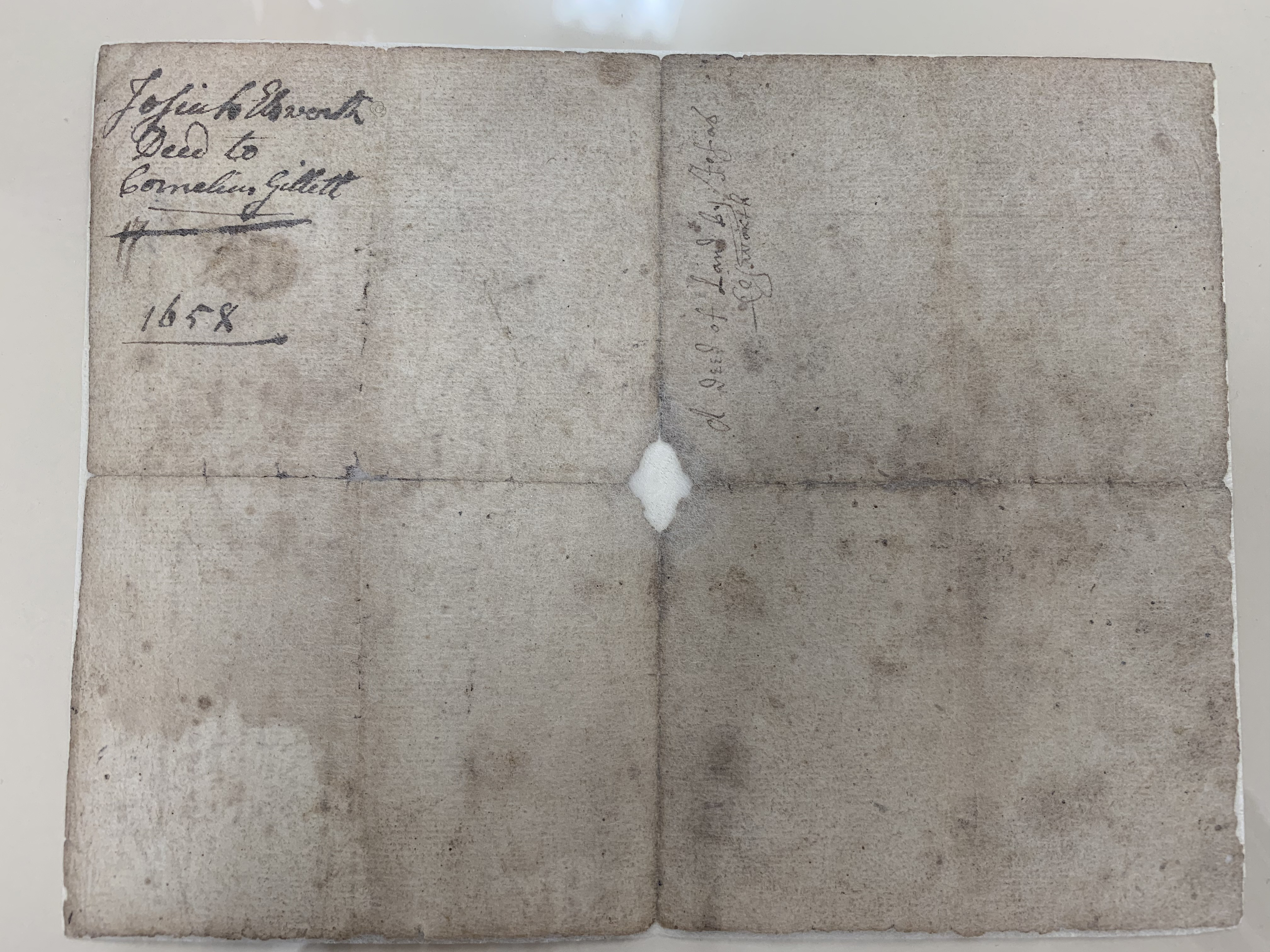
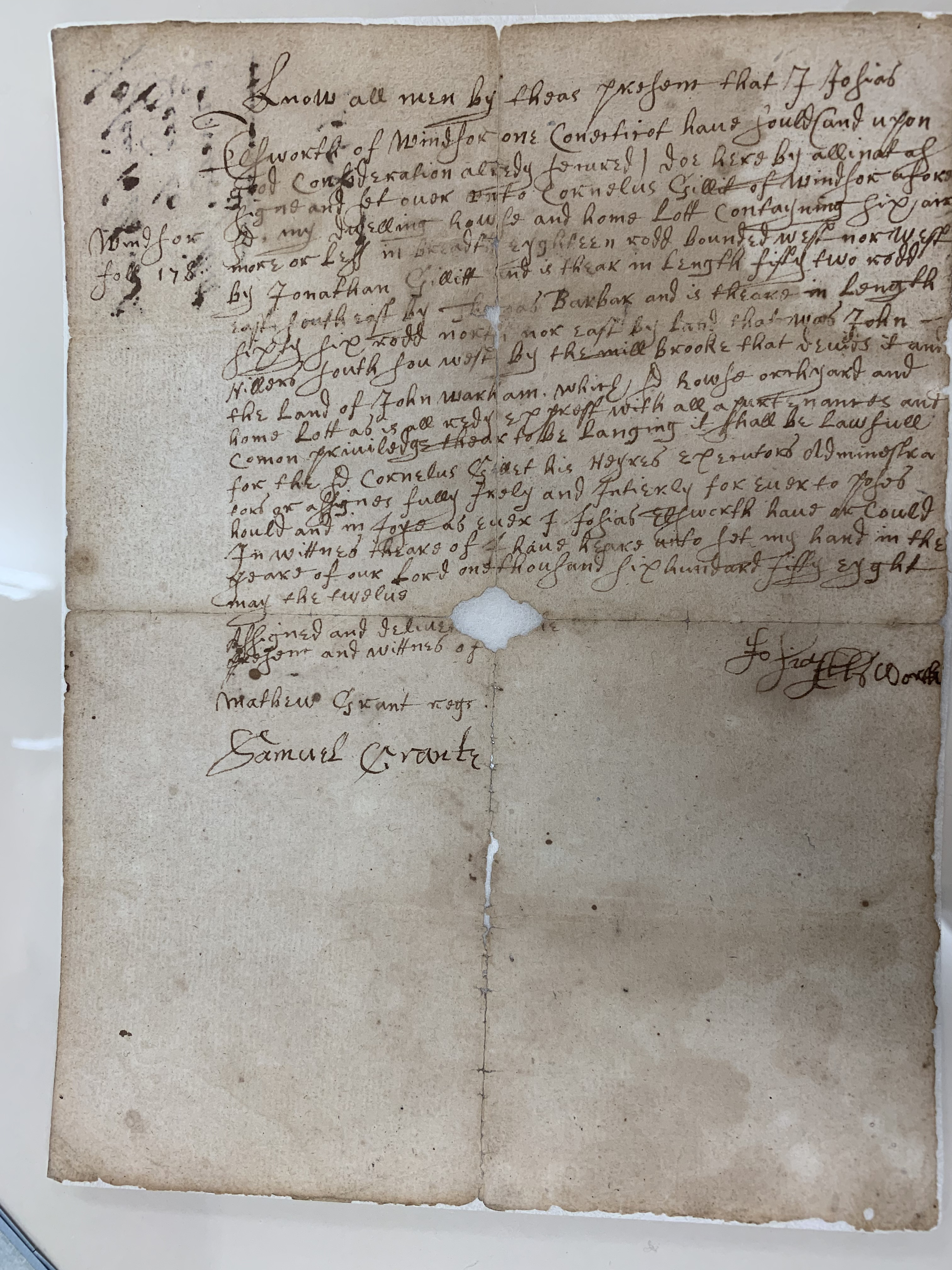
Another fun aside: I get brain dead when I’ve looked at too many documents. I was ready to go, cooling the neural connections, standing beside a bookshelf waiting to see another gem, an original deed of land from Josiah Ellsworth to Cornelius Gillette (my ninth great uncle), (the land being bounded by the land of Jonathan Gillette) when I happened to glance down. Hmm, a book about Winchell genealogy. Our grandmother was an Everett, and her grandfather married a Winchell. I wonder…and there they were in the almost 3″ thick genealogy: Henry Everett and Phoebe Winchell. Luckily this book is online, because there’s no way I could dive down that rabbit hole at the end of a research day!
Deed of land bounded by Jonathan Gillette’s land, from Josiah Ellsworth to Cornelius Gillette. 1658
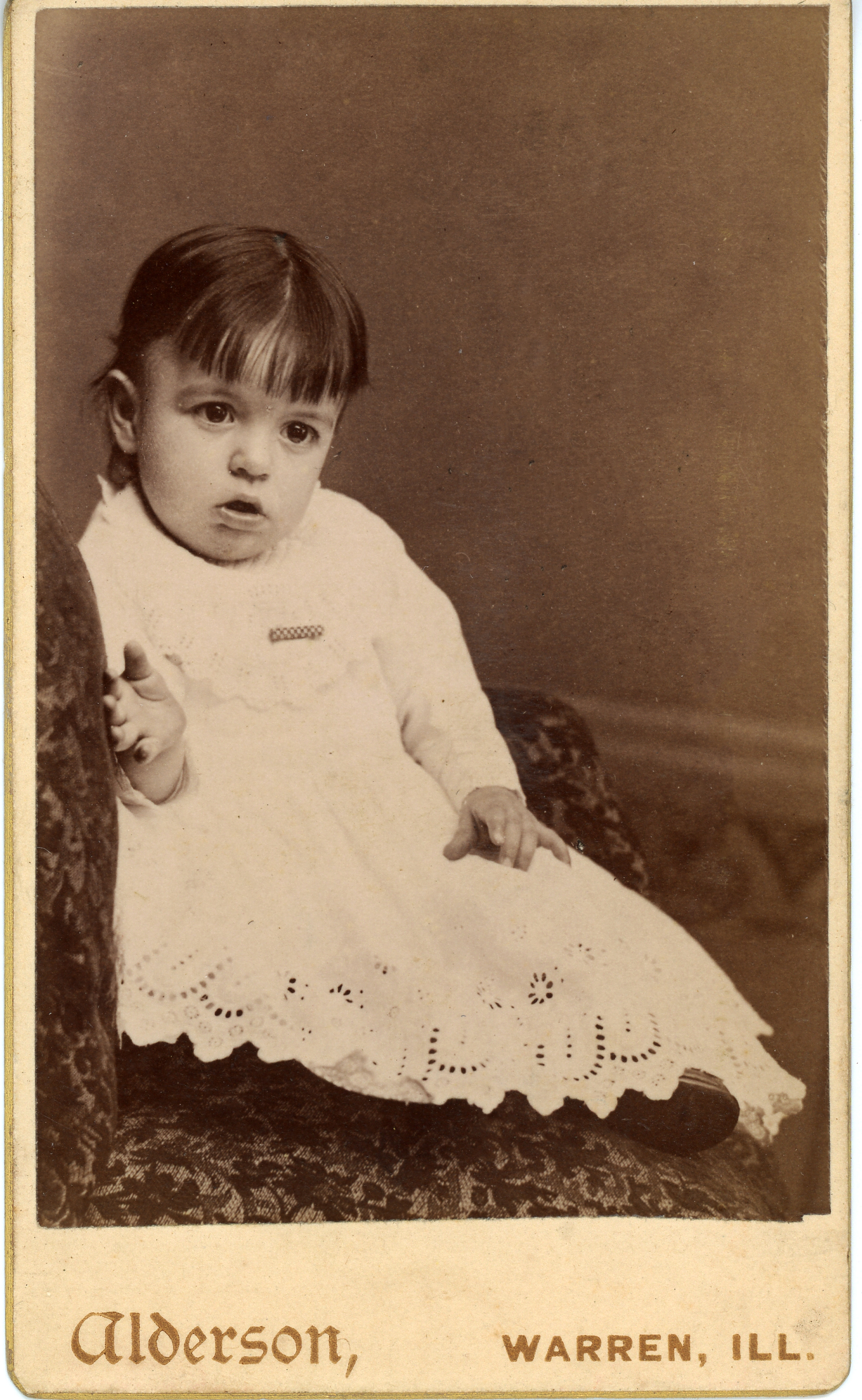
Here’s an example of the kinds of cool things that happen when you enter the world of genealogy. A few weeks ago I received an envelope from someone I’d never heard of before. When I opened it I found a picture of a 12 month old girl named Mabel Eade. The photographer was Alderson from Warren, IL. There were notes from the sender indicating that her father was Josiah Alcott Eade and her mother Carrie Kilburn Earl. She lived from 1886-1888, not a long time.
I had to look her up, but there she was in my Nana’s Earl lineage. Her mother’s name Carrie Earl clearly was connected to my great grandmother. In fact, my Nana, Carrie Earl McFadden, was born in 1867. So they were contemporaries, little Mabel in IL and baby Carrie in San Leandro, CA. Knowing the naming traditions that are common in Irish families, I’m betting there are other Carries further back in the Earl-Kilburn tree.
I was thrilled. The sender had found her picture in a Peru, IL antique mall and taken the trouble to find her on Ancestry, and then to find me and send me this picture. I scanned it and uploaded it to my ancestry tree.
Here’s the response I received, “I got your thank you card and I’m glad you received the photo and that you’re happy with it. I’m ecstatic to see it posted on Ancestry–that’s what makes it all worthwhile for me. Continued success with your tree(s)!”
At his entreaty, Mabel has been given a good home amongst our family photos.




 Following the trails of our ancestors